
WordPress Statistics 2026: 55+ Data Points on Market Share, Plugins, Security & Revenue
I've been building WordPress sites for years, and I'm tired of Googling the same stats over and over only to find outdated numbers from 2023 buried in thin listicles. So I built the reference page I actually wanted: 55+ verified data points from W3Techs, Patchstack, WooCommerce, and other primary sources — all in one place, all current.
Whether you're pitching a client on WordPress, writing a blog post, or just settling an argument about market share — bookmark this page. It's updated quarterly.
Last update: March 2026
Key Takeaways
- → WordPress powers 42.5% of all websites and 59.8% of all CMS-powered sites — still 9x larger than Shopify, its nearest competitor
- → Market share dipped from a 43.2% peak in 2022 to 42.5% — the first meaningful decline in WordPress's 23-year history
- → WooCommerce holds 33.4% of the global ecommerce market with 4.5M+ active stores generating an estimated $35B+ in yearly sales
- → 11,334 new vulnerabilities were discovered in the WordPress ecosystem in 2025 — a 42% year-over-year increase, with a median time-to-exploit of just 5 hours
- → 91% of WordPress vulnerabilities come from plugins, 9% from themes, and just 6 from core (all low priority)
- → Automattic generates ~$710M in annual revenue at a $7.5B valuation
- → The broader WordPress economy was valued at $596.7 billion in 2020 — no updated figure exists, but the ecosystem has only grown since
- → WordPress has been translated into 208 languages, making it the most globally accessible CMS
- → Elementor is used on 31% of WordPress sites, making it the single most popular extension in the ecosystem
- → WordPress 7.0 ships April 9, 2026 with built-in AI infrastructure — the biggest architectural change since Gutenberg
1. WordPress Market Share & Usage
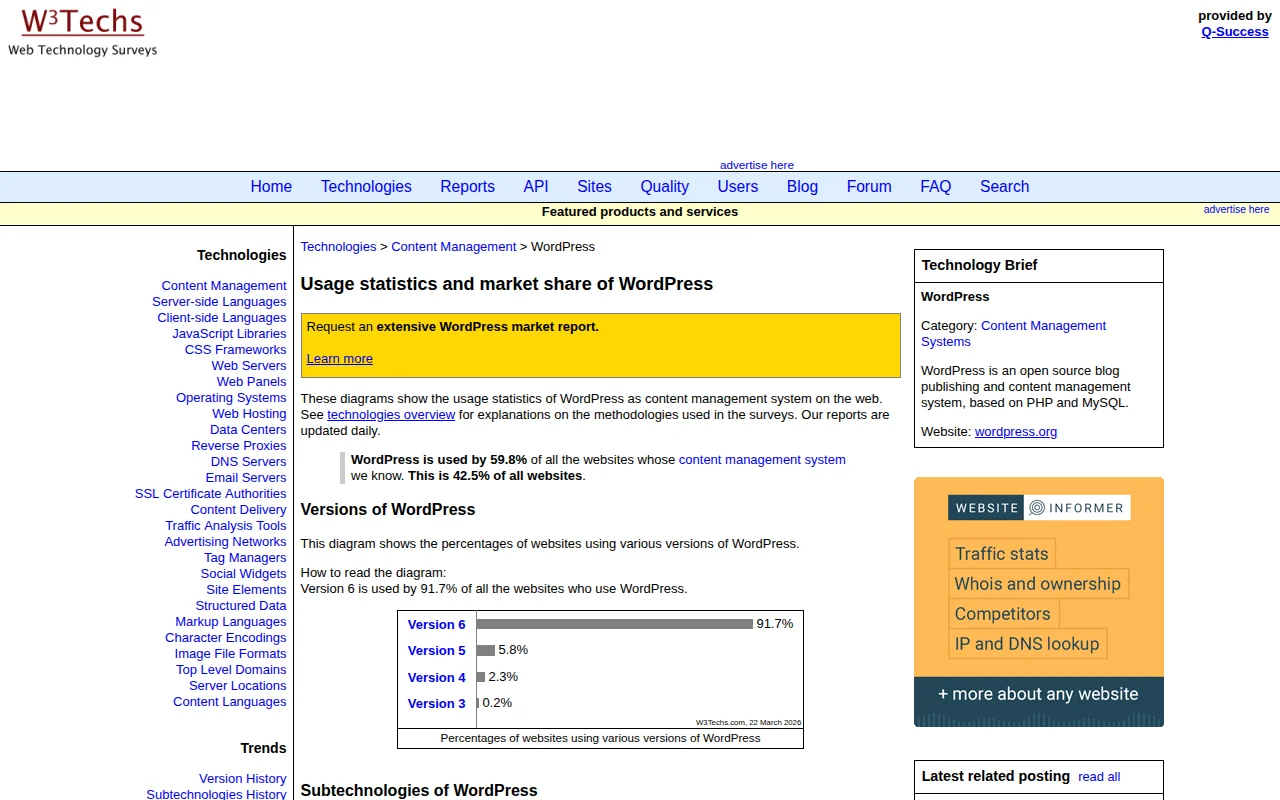
WordPress isn't just the most popular CMS — it powers more websites than all other CMS platforms combined. According to W3Techs (the most widely cited source for CMS market data), WordPress holds a 59.8% share of the CMS market as of March 2026. That means if a website uses a CMS at all, there's a 6-in-10 chance it's WordPress.
| Metric | Value | Source |
|---|---|---|
| Share of all websites | 42.5% | W3Techs (Mar 2026) |
| Share of CMS market | 59.8% | W3Techs (Mar 2026) |
| Estimated total WordPress sites | ~810 million | DemandSage |
| Live actively-visited WP sites | ~37.5 million | BuiltWith |
| Monthly unique visitors across WP sites | 409 million | WordPress.com |
| WordPress.com hosted sites | 60+ million | Automattic |
| Available in languages | 208 | WordPress.org |
The gap between "810 million" and "37.5 million" is worth explaining. The larger number includes every WordPress installation ever created — including parked domains, staging sites, and abandoned blogs. BuiltWith's figure counts only actively-visited websites, which is a more realistic measure of the live WordPress ecosystem.
WordPress Market Share Over Time (2014–2026)
WordPress more than doubled its share of the web in a decade, growing from 21% in 2014 to a peak of 43.2% in 2022. Growth has since plateaued. The HTTP Archive's 2025 Web Almanac described this as a shift "from expansion to stabilization" — not competitive displacement, but market saturation.
Source: W3Techs historical data, Kinsta WordPress Market Share Statistics
For a deeper analysis of what the 2026 dip means, see our article on WordPress market share in 2026.
2. WordPress vs. Competitors
WordPress has roughly 9x the market share of Shopify, its nearest competitor. But the competitive landscape has shifted: the platforms gaining ground (Shopify, Wix, Squarespace) are all hosted, opinionated builders — not traditional CMS competitors. Meanwhile, Joomla and Drupal (the most WordPress-like alternatives) have been losing ground steadily since 2014.
| Platform | Market Share (All Sites) | Change Since 2014 |
|---|---|---|
| WordPress | 42.5% | +21.5 pp |
| Shopify | 5.1% | +5.0 pp |
| Wix | 4.2% | +4.1 pp |
| Squarespace | 2.5% | +2.4 pp |
| Joomla | 1.4% | −1.5 pp |
| Drupal | 0.9% | −1.2 pp |
Source: W3Techs (March 2026), Kinsta historical data. "pp" = percentage points.
The takeaway: WordPress isn't losing to its competitors — the web is growing, and new types of platforms are serving users who previously would have built nothing at all. For a full SEO comparison across platforms, see Is WordPress Good for SEO?
3. Plugin & Theme Ecosystem
WordPress's plugin ecosystem is its single biggest competitive advantage. No other platform comes close to 61,000+ free extensions. The total number of tracked plugins (including premium and abandoned) reaches 112,272 according to Patchstack's security database — a number that also explains the security challenges covered in section 5.
| Metric | Value | Source |
|---|---|---|
| Free plugins in directory | 61,000+ | WordPress.org |
| Total tracked plugins (incl. premium) | 112,272 | Patchstack |
| Free themes in directory | 9,000+ | WordPress.org |
| Total tracked themes | 30,165 | Patchstack |
| Total plugin downloads (all-time) | 1 billion+ | WordPress.org |
| Average premium plugin price | $77.57 | CodeinWP |
| Average premium theme price | ~$59 | ThemeForest |
Most Popular WordPress Extensions by Usage
These are the most widely used technologies across all WordPress sites, according to W3Techs. Elementor's dominance at 31% is remarkable — nearly one in three WordPress sites uses it as a page builder.
Source: W3Techs, March 2026. Percentage of WordPress sites using each technology.
For individual plugin reviews, see our best SEO plugins comparison and full plugin directory.
4. WooCommerce & Ecommerce
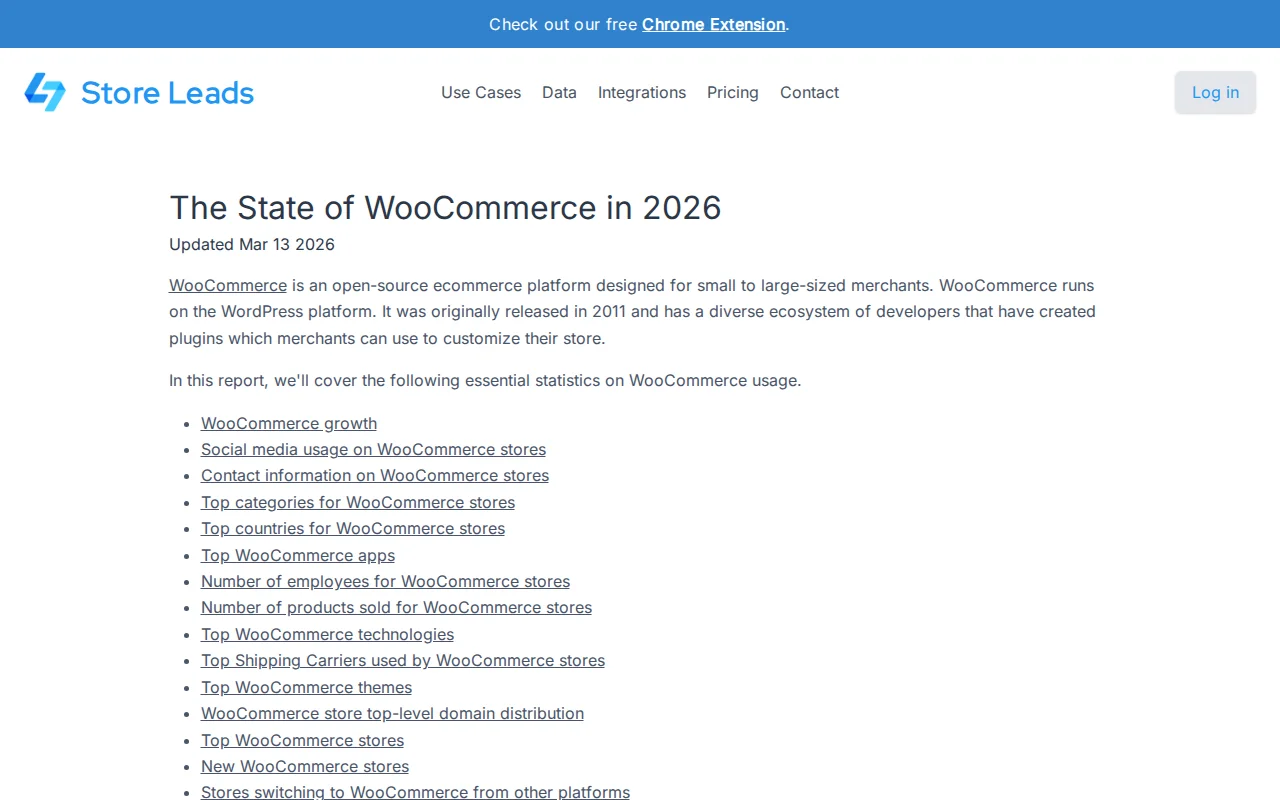
WooCommerce is the world's most widely used ecommerce platform by store count. It powers one in three online stores globally, with an estimated $35 billion+ flowing through WooCommerce checkouts every year. However, it's worth noting that in the high-traffic ecommerce segment, Shopify leads at 28.8% vs. WooCommerce's 18.2% — a sign that enterprise merchants increasingly prefer managed platforms.
| Metric | Value | Source |
|---|---|---|
| Global ecommerce market share | 33.4% | StoreLeads |
| Active WooCommerce stores | 4.5 million+ | StoreLeads |
| WooCommerce downloads (all-time) | 382 million+ | WordPress.org |
| Downloads per day | ~50,000 | WordPress.org |
| Estimated yearly GMV | $35 billion+ | Blacksmith Agency |
| Stores earning $100K+/year | 12,600+ | StoreLeads |
| Stores earning $1M+/year | 300+ | StoreLeads |
| % of WP sites using WooCommerce | 20.1% | W3Techs |
| High-traffic ecommerce share | 18.2% (vs. Shopify 28.8%) | BuiltWith |
5. WordPress Security
This is the section most people don't want to read — but it's the most important. Patchstack's State of WordPress Security 2026 report paints a sobering picture: vulnerabilities are increasing faster than ever, exploits happen within hours, and traditional defenses catch less than a quarter of attacks.
| Metric | Value | Source |
|---|---|---|
| New vulnerabilities (2025) | 11,334 | Patchstack |
| Year-over-year increase | +42% | Patchstack |
| High-severity vulnerabilities | 1,966 (17%) | Patchstack |
| Vulnerabilities in plugins | 91% | Patchstack |
| Vulnerabilities in themes | 9% | Patchstack |
| Vulnerabilities in core | 6 (all low priority) | Patchstack |
| Unpatched at time of disclosure | 46% | Patchstack |
| Exploited within 6 hours | 20% | Patchstack |
| Exploited within 24 hours | 45% | Patchstack |
| Exploited within 7 days | 70% | Patchstack |
| Traditional WAF block rate | 12–26% | Patchstack |
| Total tracked vulnerabilities (all-time) | 64,782 | WPScan |
The 5-hour exploit window is the most actionable number here. It means the old approach of "I'll update my plugins this weekend" is no longer viable — by the time you get to it, your site may already be compromised. Enable automatic updates for plugins and themes, or use a virtual patching solution.
6. WordPress Version Adoption
One positive sign for ecosystem health: 91.7% of WordPress sites run the latest major version branch (6.x). This means the vast majority of sites are actively maintained and receiving security updates. Only 2.5% of sites still run version 4.x or older — a significant improvement from five years ago.
| Version | Adoption Rate | Note |
|---|---|---|
| Version 6.x | 91.7% | Current major branch |
| Version 5.x | 5.8% | Released 2018–2022 |
| Version 4.x | 2.3% | End of life — security risk |
| Version 3.x or older | 0.2% | Severely outdated |
Source: W3Techs, March 2026
WordPress 7.0 arrives April 9, 2026 with Real-Time Collaboration, AI Connectors, and a refreshed admin UI.
7. WordPress Economy & Revenue
WordPress is both free software and a multi-billion dollar economy. Automattic (the company behind WordPress.com, WooCommerce, Jetpack, and Tumblr) generates an estimated $710 million in annual revenue. But Automattic is just one piece — the broader ecosystem of hosting companies, theme shops, plugin developers, agencies, and freelancers was valued at $596.7 billion in 2020 by WP Engine's economic study. No updated figure exists, but the ecosystem has only expanded since.
| Metric | Value | Source |
|---|---|---|
| WordPress ecosystem value | $596.7 billion (2020) | WP Engine |
| Automattic valuation | $7.5 billion | Crunchbase |
| Automattic annual revenue | ~$710 million (2024) | Latka |
| Automattic employees | ~1,900 | Automattic |
| Core committers (with access) | ~50 | Make WordPress |
It's worth noting that Automattic's $7.5B valuation represents a 63.5% decline from BlackRock's 2021 investment — a correction that mirrors the broader tech valuation downturn rather than anything WordPress-specific.
8. WordPress Community & Events
WordPress returns to a three-release cadence in 2026 after two years of slowing down (2024 saw two major releases, 2025 saw just one). Each release is deliberately timed to coincide with one of the project's flagship community events — a strategy designed to maximize contributor participation and energy.
| Metric | Value | Source |
|---|---|---|
| Major releases planned (2026) | 3 (7.0, 7.1, 7.2) | Make WordPress |
| Release cadence | Every 4 months | Make WordPress |
| WordPress 7.0 release date | April 9, 2026 (WordCamp Asia) | WordPress.org |
| WordPress 7.1 release date | August 19, 2026 (WordCamp US) | WordPress.org |
| WordPress 7.2 release date | Dec 8–10, 2026 (State of the Word) | WordPress.org |
| WordCamp Asia 2026 location | Mumbai, India | WordCamp Asia |
| Expected attendees (WCASIA) | 3,000+ | WordCamp Asia |
| Gutenberg translations | 56 locales | WordPress.org |
For the full release calendar and what it means for site owners, see our article on the 2026 three-release schedule.
9. WordPress & AI (2026)
2026 is the year WordPress went all-in on AI. The project formed a dedicated AI Team, published its first roadmap, and is shipping AI infrastructure directly into core with WordPress 7.0. This isn't about adding a chatbot — it's about making WordPress a platform that AI agents can interact with programmatically.
What's shipping in WordPress 7.0 (April 9):
- Connectors API — Centralized credential management for AI providers (Settings → Connectors)
- PHP AI Client SDK (wp-ai-client) — Provider-agnostic interface so developers write AI features once, work across OpenAI, Claude, and Gemini
- Content Guidelines — Structured storage for brand voice rules that AI tools can reference
- MCP Adapter — Model Context Protocol support so external AI agents (Claude, ChatGPT, Cursor) can interact with WordPress sites
- AI Experiments Plugin — Sandbox for testing workflow builders, embedded agents, and WP-CLI support
For the full story, see our coverage of the WordPress AI Team roadmap, the Connectors API, and Content Guidelines.
10. WordPress Hosting & Performance
WordPress hosting spans everything from $3/month shared plans to enterprise-grade managed platforms. The ecosystem's health depends on the hosting layer — fast, secure hosting with PHP 8.x and HTTPS produces dramatically better results than a $3 shared account running PHP 7.4.
| Metric | Value | Source |
|---|---|---|
| Sites using PHP 8.x | ~65% | WordPress.org |
| Sites with SSL/HTTPS | ~95% | W3Techs |
| Jetpack active installations | 27 million | Automattic |
| WP usage among top 10K sites (CMS share) | ~58% | W3Techs |
The 58% CMS share among the top 10,000 highest-traffic websites is a strong signal: WordPress isn't just popular with small sites — it powers enterprise-scale operations including TechCrunch, The New Yorker, BBC America, Time, Sony Music, Vogue, and Reuters.
Sources
All statistics in this article are sourced from primary data providers. We verify each data point before inclusion and update this page quarterly.
- W3Techs — WordPress Usage Statistics (March 2026)
- Patchstack — State of WordPress Security in 2026
- StoreLeads — State of WooCommerce in 2026
- Kinsta — WordPress Market Share Statistics (2011–2026)
- DemandSage — WordPress Statistics 2026
- DiviFlash — 45+ WordPress Statistics 2026
- Hostinger — WordPress Statistics & Market Trends 2026
- WPBeginner — WordPress Market Share Report 2026
- WordPress.org — Roadmap
- Contrary Research — Automattic Business Breakdown
This article is updated quarterly. If you cite any of these statistics in your content, we'd appreciate a link back to this page as your source.

Written by Marvin Kweyu
Our team tests and reviews WordPress products to help beginners make confident choices.
Learn more about our team →You might also like
WordPress Market Share Dips to 42.5%: Stabilization, Not Decline
WordPress’s share of all websites has slipped from a 43.2% peak in 2022 to 42.5% in March 2026. But with 9x the market share of its nearest competitor, the numbers tell a stabilization story, not a collapse.
post2026 EU Tax Changes Hit WooCommerce Stores: New VAT Rates and a €3 Customs Duty on Every Parcel
Multiple EU countries changed VAT rates on January 1, and a new €3 customs duty on low-value parcels from outside the EU takes effect July 1. Here’s what WooCommerce store owners need to update.
postWooCommerce 10.6 Drops: Faster Dashboard, Smarter Blocks, and Fewer Database Queries
WooCommerce 10.6 ships with enhanced product collection blocks, cart and checkout design polish, and meaningful database performance improvements across the board.
postCritical WooCommerce Vulnerability Patched: CSRF Flaw Could Create Rogue Admin Accounts
A critical CSRF vulnerability affecting 52 WooCommerce versions (5.4–10.5.2) could let attackers create admin accounts and access customer data. Auto-patches rolled out March 2.